

Jalalabad Blind Welfare Association, a medico- social voluntary organization was established on 17th December, 1964. It was named after the great Saint HazratShahjalal (R.A) Mujarrad Yemeni.
Social workers, business circle, elites, students, doctors & well wishers from different walks, with the active support & co-operation of District Administration met in the month of Holy Ramadan & organized the first pilot Eye Camp at Govt. Alia Madrasha, Sylhet. The Eminent eye specialist Dr. T. Ahmed FRCS inaugurated the project on 17th January. 1965. The Association continued organizing Eye camps at the same venue every year successfully amidst great enthusiasm till 1973.
To have a permanent abode the Association started its organizational works in a tin shed house located at Islampur, Sylhet in the year in 1973. On 7th September, 1975 the Association started JALALABAD EYE HOSPITAL initially with twenty-five beds in a humble way but with great hope. Relentless efforts of the dedicated volunteers achieved desired goal.
As voluntary & generous organization, the objective of the Association is giving light to blind, treating the unprivileged eye patients, organizing eye camps at different locations of Sylhet & outside. The unprivileged poor people find it difficult to get rid of the eye ailments due to poverty & for want of proper & timely treatment. Ultimately they pass the whole life in darkness facing all sorts of problems & become a great burden in the family. Keeping this in mind, the Association took the initiative to help these unprivileged people. The Association sincerely hopes that they can expand their activities more in the coming days provided the generous people extend their all sorts of co-operation & support.
At present in the hospital there are two buildings for indoor & outdoor patients measuring 8000 sft. & 2500 sft. respectively equipped with necessary apparatus & arrangements. At present there are forty-two beds & cabins for male & female patients.
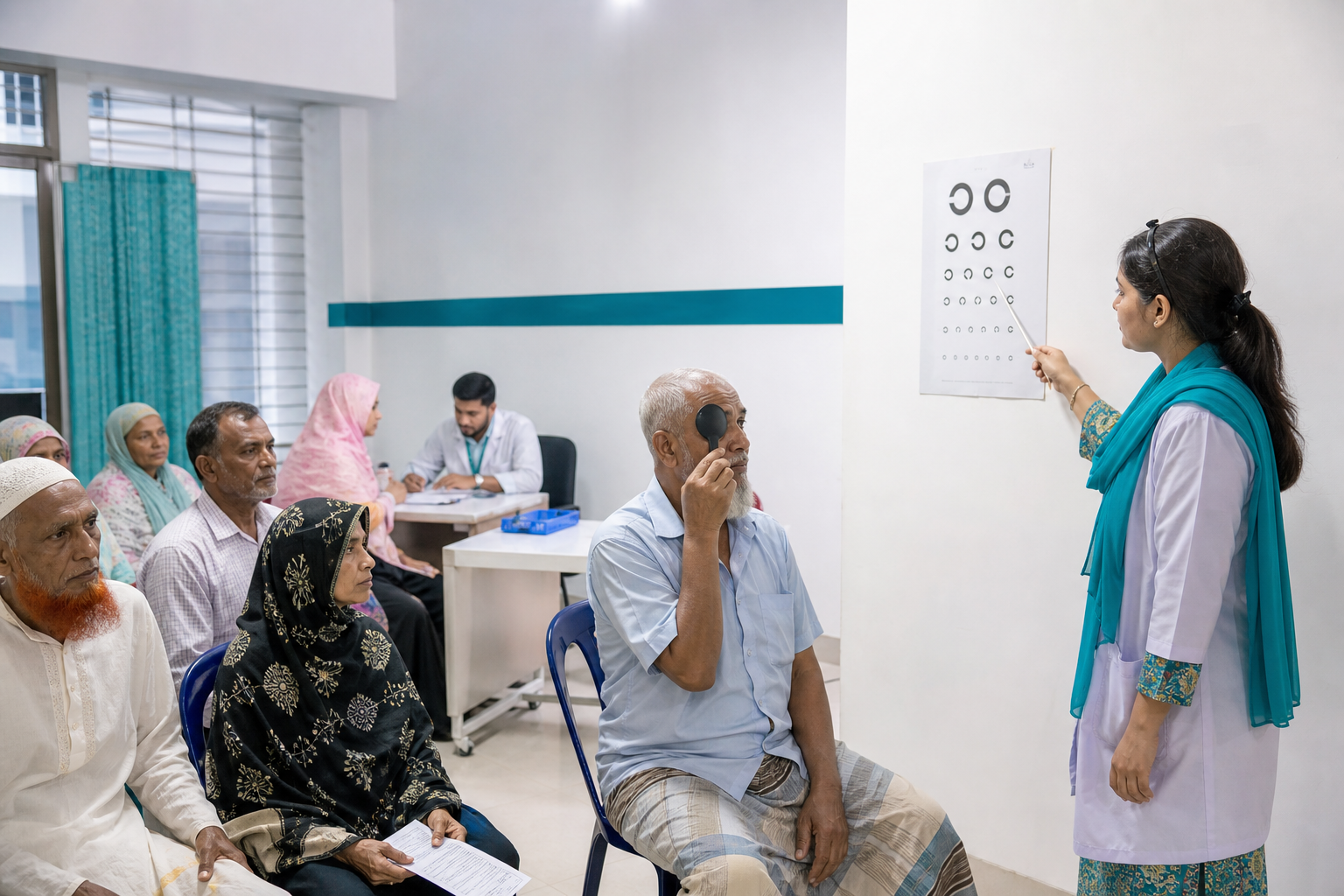
Monthly average 1600 outdoor & 130 indoor patients are receiving treatment. Indoor facilities include septic aseptic OT, generator for emergency need, running water facility, kitchen, sterilization room, slit lamps, operation microscope, refractometer & necessary others appliances. Cataract patients are implanted with intra ocular lens. Seven ophthalmologists among them for specialist surgeons are rendering services.
The number of patients are increasing day by day. To give treatment to all attending patients, it is now essential to extend treatment facilities of hospital in all respect.
Bangladesh is one of the most heavily populated country of the world where the main cause of blindness are cataract, corneal ulcer, glad, conga. Most of the blinds are avoidable with proper treatment. So hospital should have modern facilities with well equipped pathological laboratory and motivation to the patients that they should avail the facilities at right time.